top of page


DC3
Process intensification for bioelectro CO2 recycling into carbon-neutral products
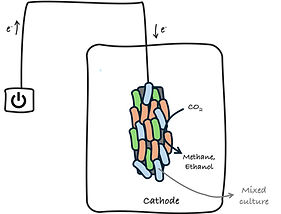
- 01The main aim of the project is to intensify microbial electrosynthesis (MES) for efficient ethanol production from CO₂ and renewable electricity, positioning it as a sustainable and scalable alternative to fossil-based chemical processes. Ethanol is the primary target product, and the technology will be validated at Technology Readiness Level 5 (TRL 5) using real industrial CO₂-containing flue gases.
- 02The project combines upgraded MES reactors with real-time control systems for dynamic process optimisation. Two bench-scale systems will be enhanced with zero-gap flow cells and gas diffusion electrodes. Key variables such as pH, gas composition, and current supply will be systematically varied. Product formation will be analysed via chromatography, while microbial dynamics will be studied through DNA sequencing and metabolic modelling.
- 03The project hypothesises that the digital transformation of MES, combined with gas diffusion electrodes, will enhance gas–liquid mass transfer and enable precise real-time control, steering the process towards industrial scalability. This approach is expected to optimise conditions that favour ethanol production over by-products like acetate.
- 04The MES systems will be inoculated with electroactive acetogenic bacteria, specifically Eubacterium limosum and Clostridium ljungdahlii. These strains are well known for their ability to convert CO₂ and H₂ into biofuels and will be studied under various controlled conditions to assess their performance and adaptability within the intensified reactor systems.
- 05The expected outcomes include a highly efficient MES reactor design capable of producing ethanol and methane at significantly higher rates than current benchmarks. A real-time control system will be developed and validated for autonomous, selective production. The research is also expected to contribute to the digitalisation of MES systems, supporting future integration with renewable energy infrastructures.
- 06Key risks include performance loss due to gas impurities and microbial activity decline, which could limit production rates. These will be addressed through gas purification, bioaugmentation strategies, and possible reactor redesign. Achieving stable real-time control under fluctuating conditions also poses a challenge, requiring robust datasets and model calibration.
- 07This project will be carried out in collaboration with Dr Deepak Pant (VITO), who will also serve as a supervisor. VITO will be responsible for electrode fabrication and system upscaling. In addition, the research fellow will undertake a secondment at AQUA to conduct a techno-economic analysis based on the experimental data generated during the project.
THE SUPERVISORS

Sebastià Puig
University de Girona

Deepak Pant
VITO
THE CANDIDATE
Jose Daniel Izquierdo Moreno
Passionate about advancing microbial electrochemical technologies for sustainable CO₂ conversion into value-added products


bottom of page